
Exec paper 1/7
AI-Augmented Organizations
Executive Paper 1/7
AI Works. Your Organization Doesn't.
Why AI Doesn't Deliver the Value We ExpectThis paper is part of AI-Augmented Organizations, a series of executive perspectives on how organizations must evolve as artificial intelligence becomes part of how the enterprise decides and acts.
Estimated reading time: 6 minutes
Chris Lederrey
https://www.aetheris.ch
https://www.linkedin.com/in/chrislederrey
Executive Summary
Every board these days asks some version of the same question: we've invested in the platforms, the models, the copilots, the agents — so why hasn't the value shown up on our numbers?
The usual answers: bad data, weak skills, low trust, resistant culture, immature governance are all real.
But they're symptoms, not causes. The deeper issue is that we've installed new AI capability into an old operating model and hoped the algorithms would do the rest of the work for us. They don't. They do the opposite: they magnify the friction between new technology and pre-AI ways of deciding.
Technology gives us new capability. Organizational transformation is what turns that capability into enterprise value.
Leadership's job is to orchestrate the two, and that's the real subject of this paper.
Why AI Doesn't Deliver the Value We Expect
Artificial intelligence has moved from the lab to the boardroom faster than almost any technology I've seen in my career. Copilots, predictive models, autonomous agents, decision-support systems, the pace of deployment across industries has been remarkable, and the technology itself has largely earned its reputation. And yet, in conversation after conversation, executives tell me the same thing: the business impact has fallen short of what was promised.
I sat recently with a COO who had rolled out a demand-forecasting model his team genuinely admired: more accurate than anything they'd had before. Six months in, planners were still overriding it by hand, because the sign-off process for a forecast hadn't changed since before the model existed. The algorithm had improved. The decision it fed into hadn't. That gap is the story of this entire paper.
AI sharpens a task here, speeds up a process there, produces a pocket of productivity somewhere in the middle of the org chart — but it rarely moves the performance of the enterprise as a whole.When that gap shows up, we tend to reach for the same explanations.We point to poor data quality. We blame incomplete master data. We fund another AI literacy program. We tighten change management. We ask the vendor for a more explainable model. We add another layer of governance.
Every one of these gets funded. None of them gets us there.
None of that is wrong, exactly. Each of these matters, and I'd be the first to fund a fix for any of them. The problem is that we treat them as root causes, when most of the time they are symptoms of something we haven't been willing to look at directly.
The Question Nobody Wants to Ask Five Times
There's a discipline I learned early in operations and still rely on: the Five Whys. Instead of stopping at the first plausible explanation, you keep asking why until you hit something you can actually act on.
Run it on AI transformation and the conversation gets uncomfortably familiar, fast.
The AI's recommendations aren't reliable:
1. Why? Because the underlying data is inconsistent.
2. Why? Because ownership of that data is split across functions.
3. Why? Because our processes were never built to produce one consistent version of enterprise data in the first place.
4. Why? Because governance is still organized function by function, not around the decision itself.
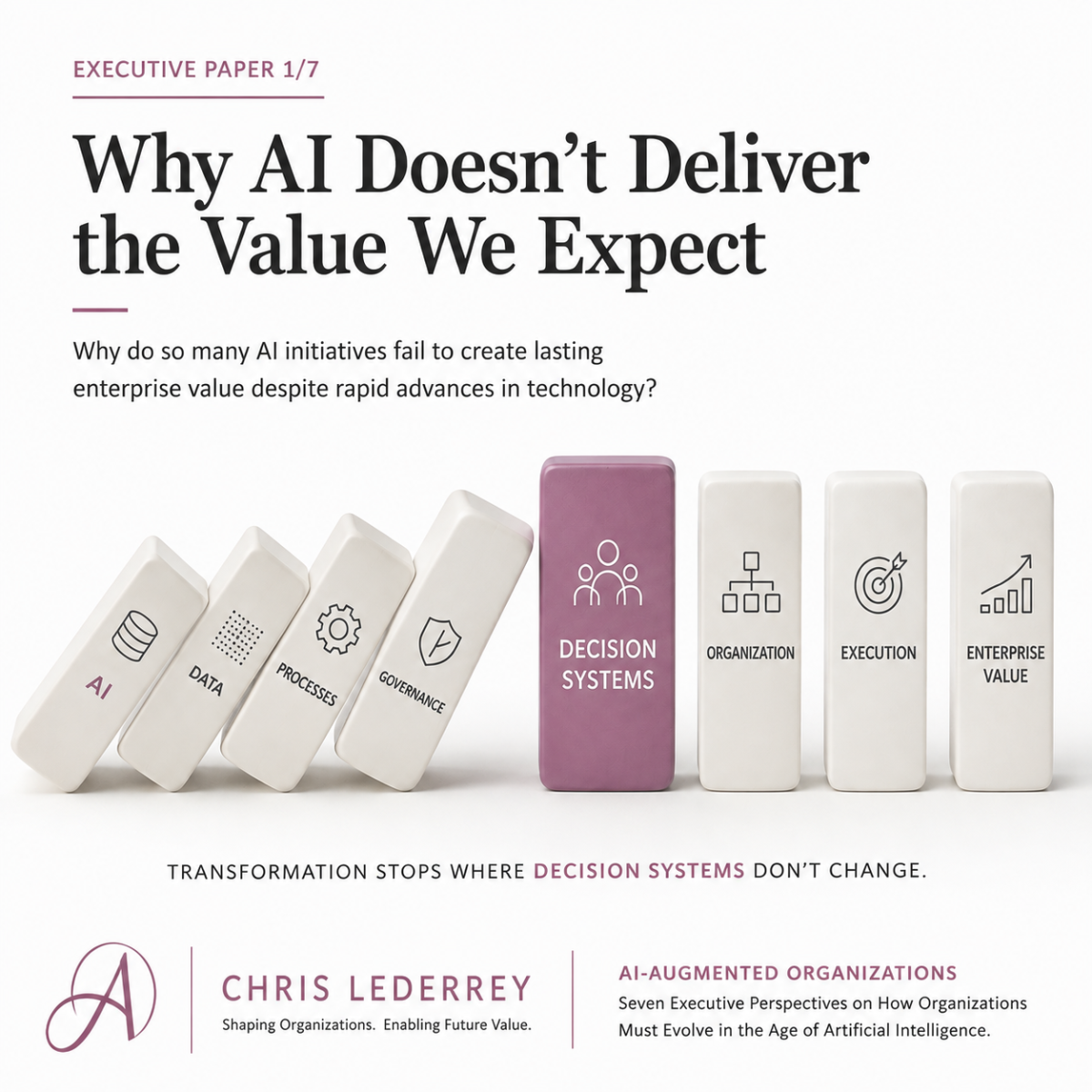
5. Why? Because we introduced AI on top of the organization we already had, instead of asking what decisions this organization now needs to make differently.
By the fifth why, we're no longer talking about technology at all. We're no longer asking whether the model is accurate enough. We're asking whether the organization has actually changed.
Projects Are Manageable. Organizational Transformation Is Not.
This is, I think, the real reason so many AI initiatives stall well short of their potential.Cleaning up data quality is a project. Deploying a new forecasting model is a project. Training the workforce on generative AI is a project. Each comes with a scope, a budget, an owner, a timeline, the things we know how to manage.
Redesigning how the enterprise makes decisions is a different order of problem entirely.It changes how functions work with one another. It changes who sits at the table when a decision gets made. It changes who holds the authority to make the call. It changes what people are accountable for, how they're incentivized, and ultimately where value gets created across the business.What started as a technology initiative quietly turns into an organizational transformation, and it rarely stays inside the four walls of the function that started it.
A Supply Chain organization, for instance, can redesign much of its own house on its own authority. But the moment its decisions touch Commercial, Finance, Manufacturing, Procurement, or a regional P&L, governance stops being a local matter. New conversations must happen. Interfaces that have worked one way for years have to change. Assumptions about who owns what get challenged, sometimes for the first time in a generation.
Deploying the technology, it turns out, is the easy part. Redesigning the organization around it is the real executive challenge.
Why We Keep Solving the Easier Problem
There's a second reason we keep circling back to the same fixes.
Data quality is something you can point to. Technology is something you can procure. A training program has a start date and an end date. Decision systems don't offer us any of that comfort — they're invisible until something goes wrong.
It is far easier to launch a master data program than to redesign how your executive team actually makes decisions together. It is far easier to retrain a forecasting model than to settle who owns the forecast. It is far easier to buy another AI platform than to build the organizational conditions under which people will actually trust it enough to use it.
So we optimize what we can control, and we quietly postpone the harder work of redesigning the enterprise itself. I understand why — I've made that trade myself. But it's also, I'd argue, the single biggest reason enterprise value keeps slipping through our fingers.
From Technology Transformation to Organizational Transformation
Maybe we've simply been asking the wrong question. Instead of asking:"How do we deploy AI?"
We should be asking:"How does our organization need to evolve so AI can keep creating value?"
That single reframe changes the whole conversation. It moves us from algorithms to judgment. From tools to decision systems. From project plans to leadership.
Technology projects create capabilities. Organizational transformation enables those capabilities to create enterprise value. Leadership orchestrates the two.
Artificial intelligence is no longer just another line on the digital roadmap.It's a full enterprise redesign project.
And that, more than any shortfall in the technology, may be the real reason so many of us are still waiting for the value we were promised: redesigning how an enterprise makes decisions is one of the hardest things leadership will ever be asked to do.
Looking Ahead
If the real constraint is organizational rather than technological, the next question is no longer how to deploy better AI. It's far more fundamental.
How do organizations redesign the way they make decisions?
That question can't be answered by technology alone. It requires us to rethink how expertise is developed, where human judgment creates the greatest value, how decisions are governed, and how the organization itself adapts to increasingly intelligent technology.
The first of these challenges may also be the one we've overlooked the most. If AI increasingly performs the work through which professionals have historically built their expertise — the early drafts, the first analyses, the small errors that teach as much as the successes — a harder question follows close behind.
How will organizations keep creating the judgment on which good decisions have always depended?
That's where we begin next.
AI-Augmented Organizations — 2/7
The AI Learning Paradox
This is Paper 1 of 7 in the AI-Augmented Organizations series by Chris Lederrey.
Happy to connect on linkedIn: www.linkedin.com/in/chrislederrey
Exec paper 2/7
The AI Learning Paradox
AI-Augmented Organizations
Executive Paper 2/7
The AI Learning Paradox
How will we continue creating expertise?This paper is part of AI-Augmented Organizations, a series of executive perspectives on how organizations must evolve as artificial intelligence becomes part of how the enterprise decides and acts.
Estimated reading time: 5 minutes
Chris Lederrey
https://www.aetheris.ch
https://www.linkedin.com/in/chrislederrey
Executive Summary
Artificial intelligence is automating many of the tasks through which professionals have historically developed expertise. At first glance, that looks like an unqualified win: routine work disappears, productivity climbs, decision quality often improves.
Beneath those gains sits a paradox we haven't reckoned with. Organizations have never created expertise by training people. They've created it through experience: imperfect decisions, understanding why they were wrong, navigating uncertainty until judgment forms. If AI increasingly performs that work, where does tomorrow's judgment come from?
This isn't an argument against AI. It's an argument for redesigning, deliberately, how expertise gets built once the work that used to build it is gone.
The AI Learning Paradox
Every technological revolution changes the nature of work. This one is different.
Previous technologies automated physical effort or repetitive administration. AI automates something closer to the core of a profession: analyzing information, spotting patterns, recommending, and increasingly making decisions.
From an operational standpoint, that's precisely what we've spent years trying to build. From a leadership standpoint, it opens a question most of us haven't sat with long enough.I recently spoke with a Supply Chain director who put it more bluntly than I could have. Her best planners, she said, weren't the ones who'd read the most about forecasting, they were the ones who had been badly wrong at least once, and had to live with the consequences. Her worry wasn't that AI would out-forecast her planners. It was that her next generation of planners would never get wrong enough, early enough, to become good.
That's the question underneath this whole paper: if AI increasingly performs the work through which professionals have always learned their profession, how will organizations keep creating expertise?
Experience Is Not Taught
Professional judgment is rarely acquired in a classroom.Courses build knowledge. Experience builds judgment.
A planner doesn't get better because they attended another forecasting workshop. They get better because they've repeatedly lived through uncertainty, a forecast that missed, a promotion that distorted demand, a competitor's unexpected campaign, a supplier that failed, a pandemic that broke every assumption in the model.
Each of those moments quietly recalibrated how they understood the system.Data became context. Context became intuition. Intuition became judgment.
We tend to underestimate how much of that learning happens in the ordinary friction of the job, not in the training room.
That ordinary friction is exactly what AI is now absorbing.
The Hidden Cost of Automation
Supply Chain isn't the first function to face this. Commercial aviation has lived with it for decades.
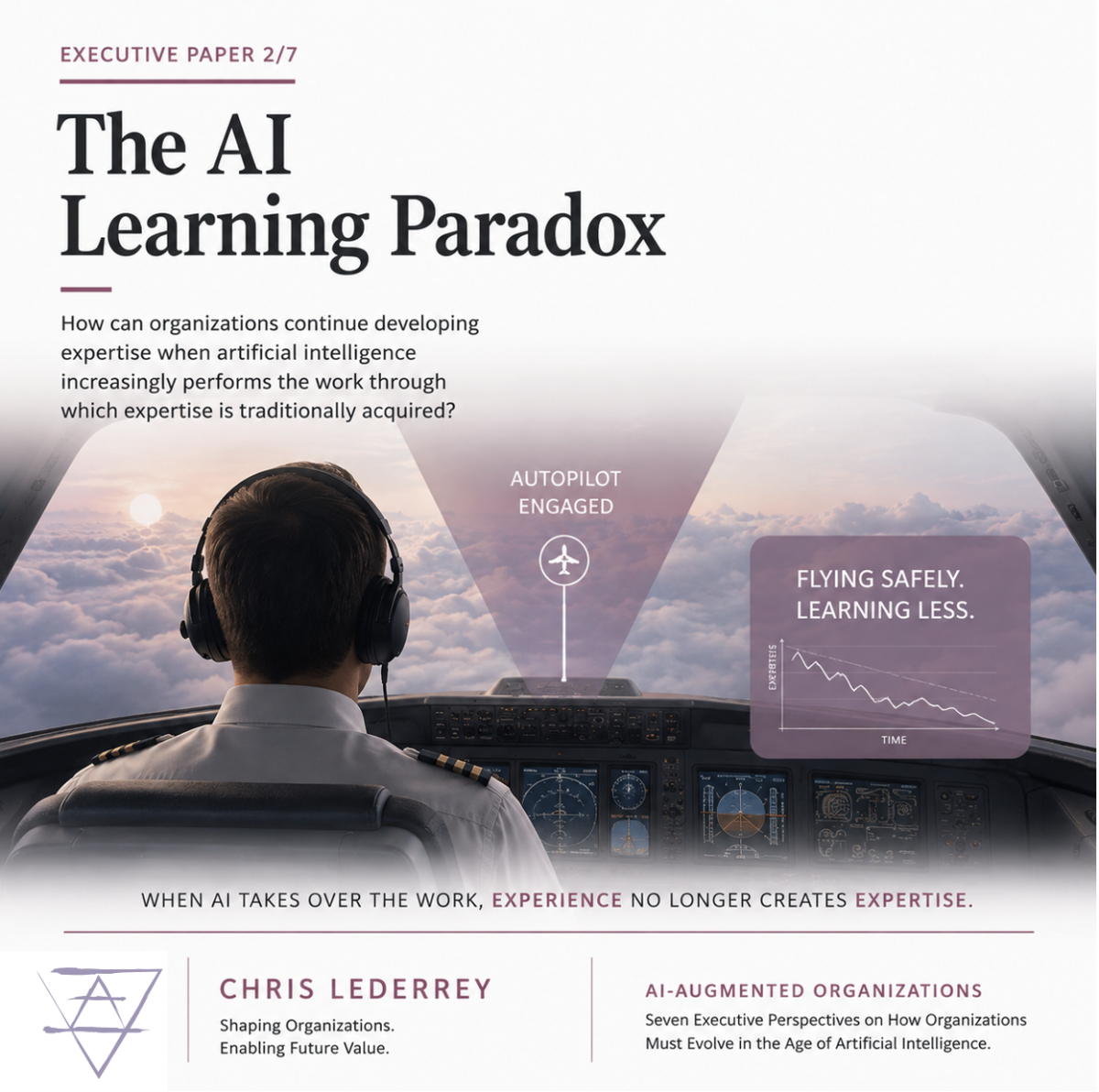
Automation has made flying dramatically safer. And yet airlines still require pilots to fly manually under the right conditions, not because the automation is untrustworthy, but for the opposite reason: relying on it exclusively slowly erodes the human skill needed for the moment automation reaches its limits.
The industry has a name for it, automation complacency and skill degradation. Nobody treats that as a failure of the automation. It's simply accepted that human expertise has to be maintained on purpose, or it quietly disappears.
Enterprise decision-making may be entering the same phase. As AI takes on more of the routine cognitive work, organizations may need to become just as deliberate about keeping human judgment alive.
The Paradox, Stated Plainly
This is, I think, one of the defining organizational questions of the AI era.The more successful AI becomes at automating routine work, the more deliberately organizations must redesign how future expertise is created.
AI improves operational performance by removing routine work. At the same time, it quietly removes the experiences through which professionals have always developed judgment.
Efficiency and capability-building used to happen together, almost by accident. They no longer do.
The paradox isn't technological. It's organizational, and closing the gap is now leadership's job, not the algorithm's.
Asking a Different Question
This should change what executives ask.Instead of asking which tasks can AI automate, we should increasingly ask which learning experiences are quietly disappearing.
Every task we hand to AI is also, potentially, an opportunity someone no longer gets to struggle through. The next question follows naturally: how do we deliberately recreate those experiences?
Simulations. Scenario exercises. Rotational assignments. Coaching. Structured decision reviews. AI-assisted learning environments built for the purpose, not repurposed from what's left over.
The specific mechanism matters far less than the principle behind it.We can no longer assume expertise will emerge on its own from the everyday work. If the everyday work is disappearing, we have to design, on purpose, how expertise gets built in its place.
Looking Ahead
If expertise now has to be deliberately designed rather than left to develop on its own, a harder question follows close behind.Not every decision deserves the same weight of human judgment. Not every task justifies the same investment in human capability.
So where, exactly, should organizations concentrate their most valuable human judgment?
That's the subject of the next Executive Paper.
AI-Augmented Organizations — 3/7
Capability Allocation
Where should human judgment create the greatest value?
This is Paper 2 of 7 in the AI-Augmented Organizations series by Chris Lederrey.
Happy to connect on linkedIn: www.linkedin.com/in/chrislederrey
Exec paper 3/7
Stop Allocating Work. Start Allocating Judgment.
AI-Augmented Organizations
Executive Paper 3/7
Where should human judgment create value?This paper is part of AI-Augmented Organizations, a series of executive perspectives on how organizations must evolve as artificial intelligence becomes part of how the enterprise decides and acts.
Estimated reading time: 5 minutes
Chris Lederrey
https://www.aetheris.ch
https://www.linkedin.com/in/chrislederrey
Executive Summary
Artificial intelligence changes more than how work gets done. It changes where human expertise is worth spending.For decades, we've distributed expertise the same way we distributed org charts: every planner planned, every buyer bought, every analyst analyzed. As routine work becomes automated, that model stops making sense and the question executives should be asking changes with it. Not how many people do we need. Where does human judgment create disproportionate value?
Capability Allocation is the deliberate discipline of putting human expertise where uncertainty, strategic stakes, and business impact justify it, and letting automation run everything else. The organizations that win this decade won't be the ones that replaced the most people with AI. They'll be the ones that figured out, with precision, where their people mattered most.
Stop Allocating Work. Start Allocating Judgment.
Once you accept that expertise has to be deliberately developed, the argument of the last paper, a harder question follows immediately. Expertise isn't free, and it isn't unlimited. You can't invest equally in every activity, and you shouldn't try.
AI changes the economics of expertise. Routine work increasingly belongs to automation. Human judgment becomes more valuable, not less, wherever uncertainty, ambiguity, and real trade-offs remain.
That leaves leadership with a responsibility most of us haven't formally owned before: not just developing capability but deciding where to spend it.
Not Every Decision Deserves the Same Expertise
For decades, organizations have distributed expertise by structure, not by value. Every planner planned. Every buyer bought. Every analyst analyzed, regardless of whether the decision in front of them was trivial or make-or-break.
AI breaks that model, because it exposes something that was always true but easy to ignore: some decisions are highly predictable, and others are genuinely uncertain. Some carry enormous strategic consequence, and others carry almost none. Treating all of them as equally deserving of scarce human attention was never efficient, we simply didn't have a way to tell the difference at scale before. Now we do. Which means leadership must ask a sharper question: where does human judgment create disproportionate value — and where is it just expensive habit?
From Work Allocation to Capability Allocation
Managers have always allocated work. Increasingly, executives will allocate judgment and that's a bigger shift than it sounds.
The old question was who should perform this task.
The new one is where should our scarcest expertise be concentrated.
As predictable work becomes automated, human capability naturally concentrates around complexity, ambiguity, and strategic weight. The organization stops optimizing workloads and starts optimizing expertise itself. That's not a subtle difference. It changes what you measure, what you staff for, and, eventually, what you pay for.
What This Looks Like in Practice
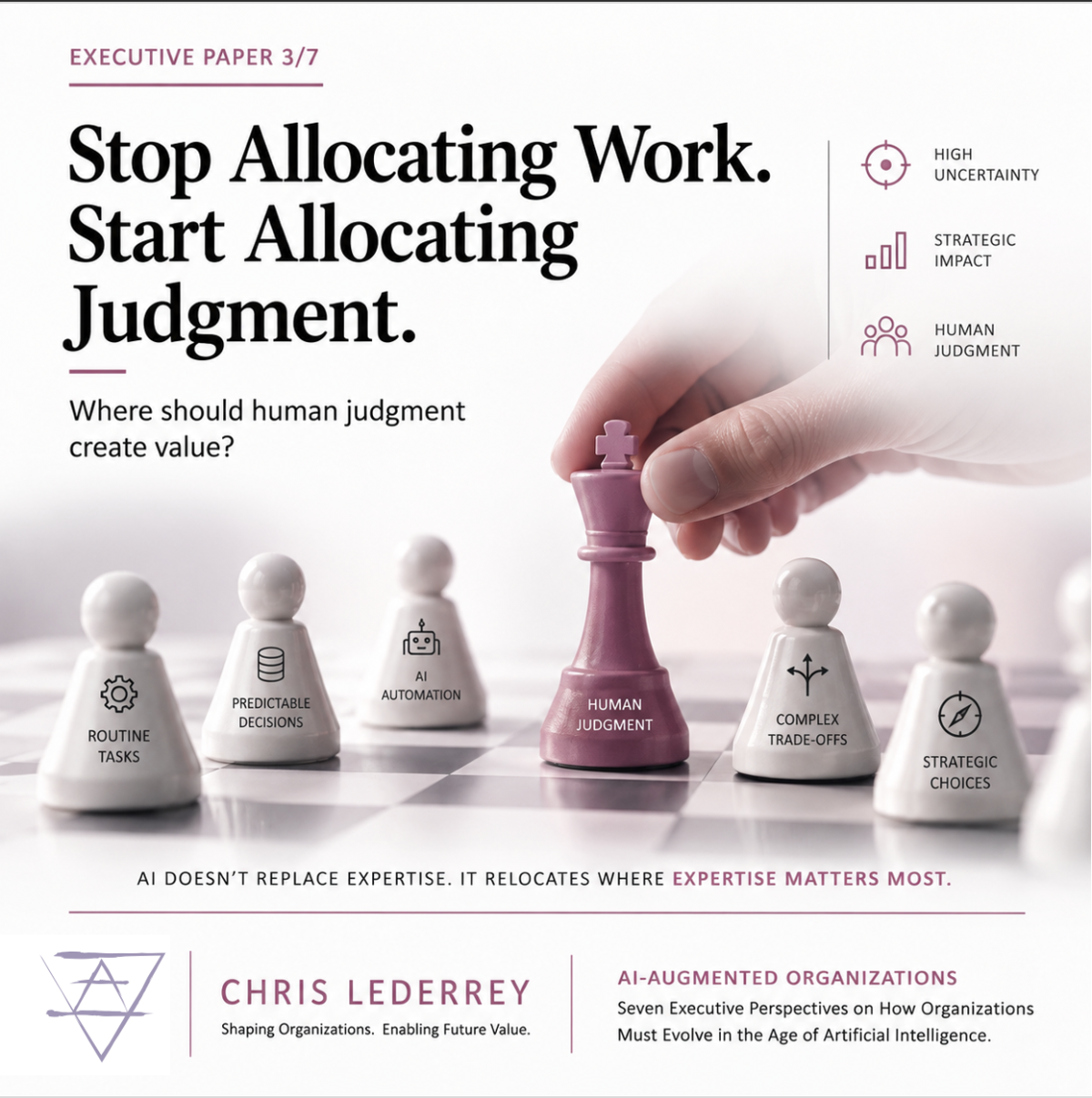
This became viscerally clear to me in demand planning.The instinct is always to assume high-value products automatically deserve the most human attention. In practice, two separate dimensions matter, and conflating them is where most organizations get the allocation wrong: business criticality, and predictability. An ABC-XYZ portfolio view makes the distinction explicit.
A highly predictable product can be enormously important to the business (e.g. AX) and still be safe to leave almost entirely to automation. Meanwhile, a product with volatile demand, heavy promotional activity, or structural uncertainty needs real human judgment layered on top of the AI's recommendation, even when it's a comparatively minor line in the portfolio (e.g. BZ).
The goal was never to maximize manual intervention. It was never to maximize automation either. It was to put human judgment exactly where it creates the most business value (e.g. AY & AZ), and nowhere else.
AI doesn't replace expertise. It relocates where expertise matters most.
What This Means for Leadership
This changes the executive agenda in a specific way. The goal is no longer automating as many tasks as possible. It's deliberately preserving human expertise wherever uncertainty is genuinely creating value — and having the discipline to let go everywhere else.
So, the question shifts from which tasks can AI automate?
to Which decisions genuinely deserve human judgment?
Capability Allocation isn't a one-time exercise. It's an organizational capability in its own right, one that has to keep evolving as the technology keeps improving.
Looking Ahead
Allocating expertise only answers part of the problem. Once you've decided where human judgment should be concentrated, a second, equally consequential question follows: who actually gets to make the call?
Which decisions should remain fundamentally human? Which should be AI-assisted? Which can safely become autonomous?
Capability Allocation answers where should we invest human expertise.
It doesn't yet answer who owns the decision once that expertise is in the room.
That's the subject of the next Executive Paper.
AI-Augmented Organizations — 4/7
Decision Governance How should decision authority evolve?
Happy to connect on linkedIn: www.linkedin.com/in/chrislederrey
Exec paper 4/7
It's Not "Can AI Decide?"
It's "Who's Accountable When It's Wrong?"
AI-Augmented Organizations
Executive Paper 4/7
It's Not "Can AI Decide?" It's "Who's Accountable When It's Wrong?"
Who should own which decisions in the age of AI?This paper is part of AI-Augmented Organizations, a series of executive perspectives on how organizations must evolve as artificial intelligence becomes part of how the enterprise decides and acts.
Estimated reading time: 6 minutes
Chris Lederrey
https://www.aetheris.ch
https://www.linkedin.com/in/chrislederrey
Executive Summary
Artificial intelligence does more than improve individual decisions. It changes who should be making them in the first place.
We've traditionally designed governance around org charts, reporting lines, and functional boundaries. AI breaks that logic. As intelligent systems become capable of recommending — or executing — a growing share of decisions, leadership has to redefine where decision authority actually sits.
This isn't primarily a technology question. It's a governance question.
Decision Governance is the deliberate design of who owns which decisions: when AI should advise, when a human should decide, when a decision can be safely automated, and — critically — who remains accountable for the outcome either way.
Organizations don't really operate through activities. They operate through decisions that trigger activities. Redesigning that decision system, deliberately, is now one of leadership's central responsibilities.
It's Not "Can AI Decide?" It's "Who's Accountable When It's Wrong?"
AI changes more than how work gets done. It changes the nature of deciding itself.
Until recently, we largely assumed every operational decision needed a human hand on it somewhere. AI breaks that assumption cleanly. Some decisions can now be automated safely. Others benefit enormously from an AI recommendation while staying under human responsibility. And some should remain fundamentally human — not because AI can't compute an answer, but because they involve uncertainty, ethics, or strategic trade-offs that technology was never built to own.So the executive question changes. It's no longer can AI support this decision. It's who should own this decision — and that's a very different question to answer.
Organizations Operate Through Decisions, Not Functions
We describe ourselves through functions — Sales, Marketing, Finance, Supply Chain, Manufacturing. But that's not actually where value gets created.
Value gets created through decisions: every forecast, every inventory target, every production plan, every investment, every price, every product launch. An organization is, in a very real sense, the sum of the decisions it makes every day.
AI doesn't just improve isolated activities inside those functions. It changes how decisions flow through the enterprise entirely — which is exactly why Decision Governance is a strategic capability, not an operational process you can hand to IT.
From Decision Support to Decision Ownership
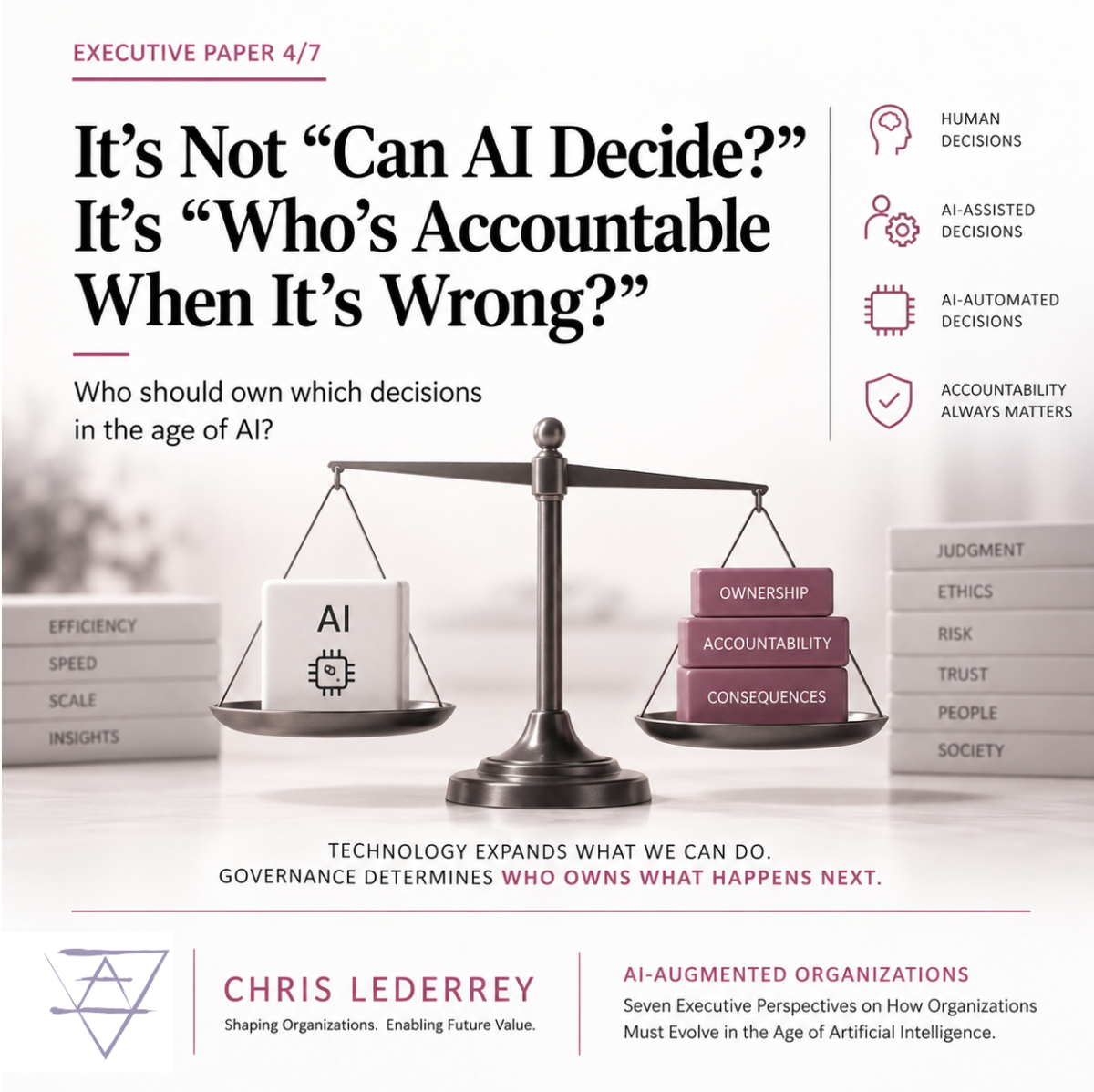
Technology used to support human decisions from the sidelines. AI increasingly sits inside the decision itself, which forces several genuinely different models to coexist:
Some decisions stay entirely human. Others become AI-recommended, human-approved. Some become AI-executed within boundaries a human set in advance. A few stay permanently reserved for executive judgment, full stop.
None of these is universally correct. The right allocation depends on strategic importance, uncertainty, regulatory exposure, organizational maturity, risk appetite, and accountability. That's precisely why Decision Governance can't be copied from a peer company's playbook — it has to be designed on purpose, for your organization, decision by decision.
Governance Is About Accountability, Not Capability
A regional Sales team I worked with had a pricing engine that could approve customer discounts automatically, within a defined band, faster than any human could. It worked beautifully, until a configuration edge case let it approve a discount that quietly breached the account's margin floor for three straight weeks before anyone noticed. The post-mortem asked the wrong question first: could the algorithm have caught this?
The question that actually mattered took longer to surface: whose job was it to notice?
That's the misconception baked into most conversations about AI and decisions. We ask can AI make this call.
The far more important question is: Who remains accountable if the decision turns out to be wrong?
AI can recommend. It can analyze. It can simulate. It can even execute predefined actions flawlessly. Accountability, however, stays fundamentally organizational, which is exactly why Decision Governance reaches well beyond technology. It defines not just how a decision gets made, but who owns what happens next. Leadership can delegate a decision to an algorithm. It cannot delegate the responsibility that comes with it.
Decision Governance Isn't a Fixed Model
This isn't a design exercise you complete once and file away. It evolves, as the organization builds confidence, as AI capability matures, as people develop judgment, as regulation shifts underneath all of it.
A decision that requires human sign-off today may be safe to automate next year. Equally, a new strategic risk may mean leadership needs to reclaim a decision it had previously, and reasonably, delegated to automation.
Good governance keeps adapting. Treating it as a one-time org chart exercise is how organizations end up with authority frozen in place two years after the conditions that justified it have changed.
What This Means for Leadership
Executives keep asking which processes should we automate.
The more useful question: which decisions should remain fundamentally human?
Organizations don't compete on technology alone. They compete on the quality, speed, and consistency of the decisions they make, day after day. Technology expands what an organization can do. Governance determines whether that expanded capability actually turns into value — or just faster mistakes.
Looking Ahead
Decision Governance defines how authority and accountability get allocated across the enterprise.
Even the most carefully designed governance model creates almost no value if the people living inside it don't actually embrace it.
Why do some organizations confidently adopt AI, while others hesitate, quietly override every recommendation, or drift back to the old way of working within a year?
The answer has less to do with technology than most of us assume. That's the subject of the next Executive Paper.
AI-Augmented Organizations — 5/7
Human Adoption
Why people rarely resist technology — but often resist what adopting it means for them.
This is Paper 4 of 7 in the AI-Augmented Organizations series by Chris Lederrey.
Happy to connect on linkedIn: www.linkedin.com/in/chrislederrey
Exec paper 5/7
People Don't Resist AI. They Resist What It Means For Them.
AI-Augmented Organizations
Executive Paper 5/7
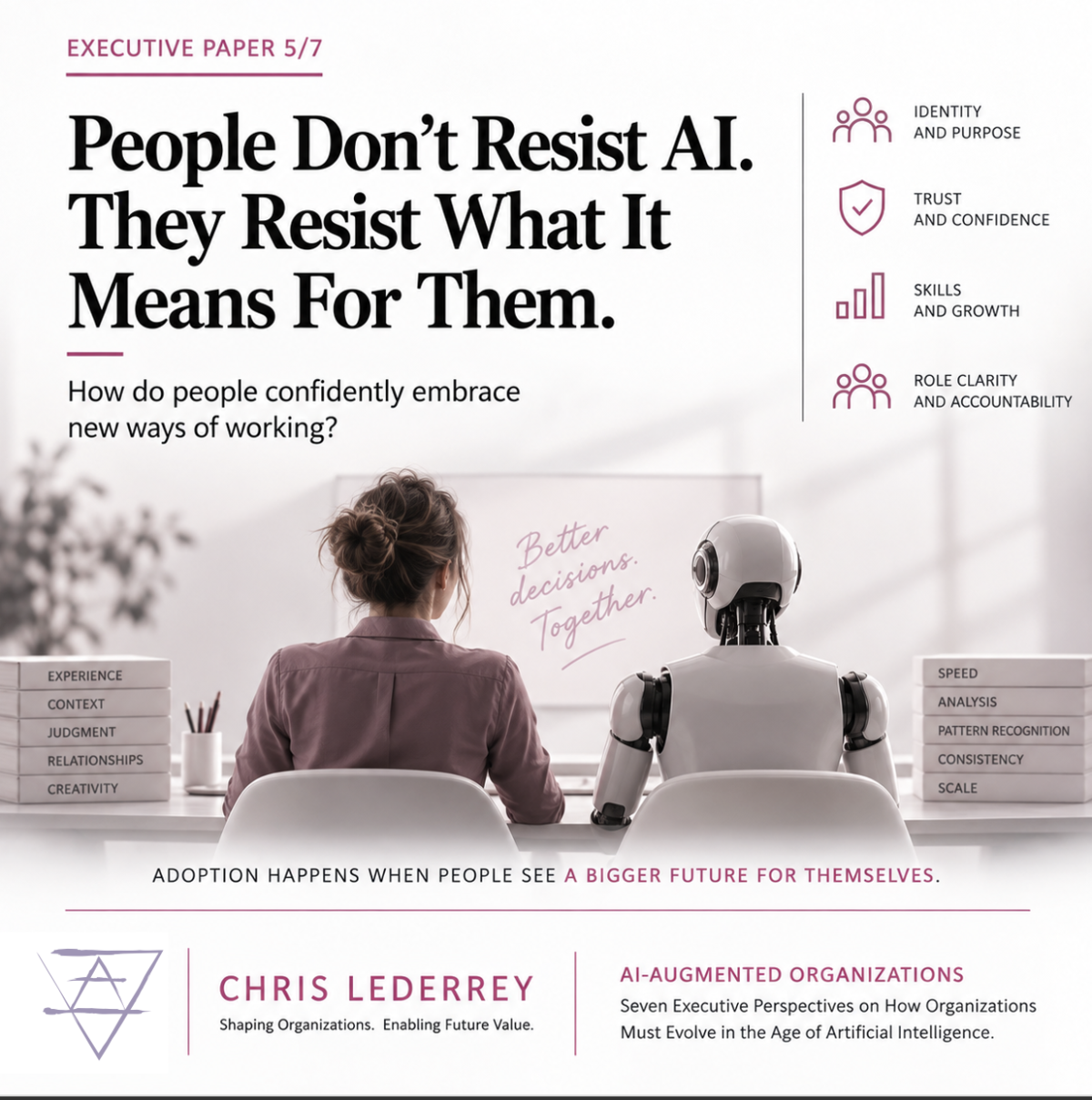
People Don't Resist AI. They Resist What It Means For Them.
How do people confidently embrace new ways of working?This paper is part of AI-Augmented Organizations, a series of executive perspectives on how organizations must evolve as artificial intelligence becomes part of how the enterprise decides and acts.
Estimated reading time: 6 minutes
Chris Lederrey
https://www.aetheris.ch
https://www.linkedin.com/in/chrislederrey
Executive Summary
We keep describing AI adoption as a technology challenge. It rarely is.Most employees don't fundamentally resist artificial intelligence. They resist what adopting it seems to mean for them: new responsibilities, a shifting sense of identity, changing authority, uncertainty about how they'll be judged, and sometimes a real question about their own future.
Trust matters. But trust alone doesn't create adoption.
What actually creates adoption is broader: organizations deliberately building the conditions under which people are willing, and able, to work alongside increasingly capable technology.
AI creates value only when people change how they work. That makes Human Adoption an organizational capability, not a change-management line item.
People Don't Resist AI. They Resist What It Means For Them.
By this point in the series, the organization has redesigned how expertise gets built, deliberately allocated that expertise where judgment creates the most value, and redefined who actually owns each decision.
One question still stands between all of that and actual results: will people embrace it?
Technology can be implemented. Capability can be developed. Governance can be redesigned. None of it guarantees adoption. Every transformation program I've been part of has had at least one technically flawless project that never once changed how people actually behaved. AI won't be the exception.
Trust Is Necessary. It Isn't Sufficient.
Most of the current conversation is about trust. Can people trust AI's outputs? Can it be explained? Can they understand how it reached a given conclusion?
These questions matter. They're not the whole story.
We tend to assume resistance means people don't trust the technology. More often, what's actually happening is more human than that. People are quietly running the consequences forward: will I still be needed? Will I lose control? Who's accountable if this recommendation turns out wrong? Will my expertise still count for something? Am I about to become less relevant?
No amount of model explainability answers those questions. They aren't technical questions. They're organizational ones.
AI Is a Colleague, Not a Piece of Software
Most organizations still roll out AI the way they'd roll out any new application: a launch date, a training deck, a help desk.
A more useful mental model: think of AI as a new member of the team, not a new tool on the desktop. Like any new colleague, it brings real strengths and real limitations. Trust isn't instant. Roles aren't obvious on day one. Collaboration has to be earned through actual working experience, people learning when to rely on it, when to challenge it, when to override it entirely.
The goal was never for AI to replace the team. It's for the team, human and AI together, to make better decisions than either could alone.
I watched this play out with a category manager who had spent fifteen years building a near-instinctive feel for her suppliers. The first month with an AI-generated risk score, she overrode it constantly, almost on principle. Three months in, she wasn't overriding less because she'd learned to trust the model, she was overriding differently, because she'd learned exactly where its judgment was strong and where hers still had to lead. That's not compliance. That's what a good working relationship with a new colleague actually looks like.
Fear Is Not the Enemy
One observation has followed me through every transformation program I've worked on: people rarely reject the technology itself. They reject what they believe adopting it will require of them.
- Sometimes it's fear of losing expertise.
- Sometimes authority.
- Sometimes identity.
- Sometimes it's nothing more dramatic than the discomfort of a routine that's about to change.
That distinction matters more than it sounds like it should, because organizations that try to build trust without addressing what's actually underneath it usually discover, expensively, that trust alone doesn't move behavior.
Human Adoption, done properly, is much bigger than communication or training. It requires:
- Leadership
- Psychological safety.
- Real clarity about who's accountable for what.
- And, above all, people actually experiencing that working alongside AI makes them more valuable, not less.
From Fear-Driven Intervention to Judgment-Driven Intervention
This reframes the role of human intervention entirely. The goal of AI was never to eliminate human involvement. It's to eliminate the unnecessary kind.
Organizations need to move deliberately from fear-driven intervention to judgment-driven intervention.
People should step in because their expertise is genuinely adding value, not because they feel compelled to keep a hand on the wheel. That single distinction may end up determining whether AI becomes a real organizational capability, or just another piece of expensive software nobody quite trusts.
What This Means for Leadership
Executives keep asking: how do we increase trust in AI?
A better question: what organizational conditions let people confidently work alongside it?
The answer is rarely found in the technology. It's found in leadership, specifically, in whether people understand their role, their accountability, their contribution, and the value they continue to create once AI is in the room.
Looking Ahead
At this point in the series, the organization has redesigned how expertise is created, deliberately allocated that expertise, redefined who owns which decisions, and built the conditions for people to genuinely adopt new ways of working.One question remains — the one that ties everything together.
What does an organization look like when none of this exists as a separate initiative anymore, but simply as how the enterprise operates?
That's the subject of the next Executive Paper
AI-Augmented Organizations — 6/7
The AI-Augmented Organization
What does an organization look like once learning, capability, governance, and human adoption become one coherent operating system?
This is Paper 5 of 7 in the AI-Augmented Organizations series by Chris Lederrey.
Happy to connect on linkedIn: www.linkedin.com/in/chrislederrey
Exec paper 6/7
The AI-Augmented Organization
AI-Augmented Organizations
Executive Paper 6/7
The AI-Augmented Organization
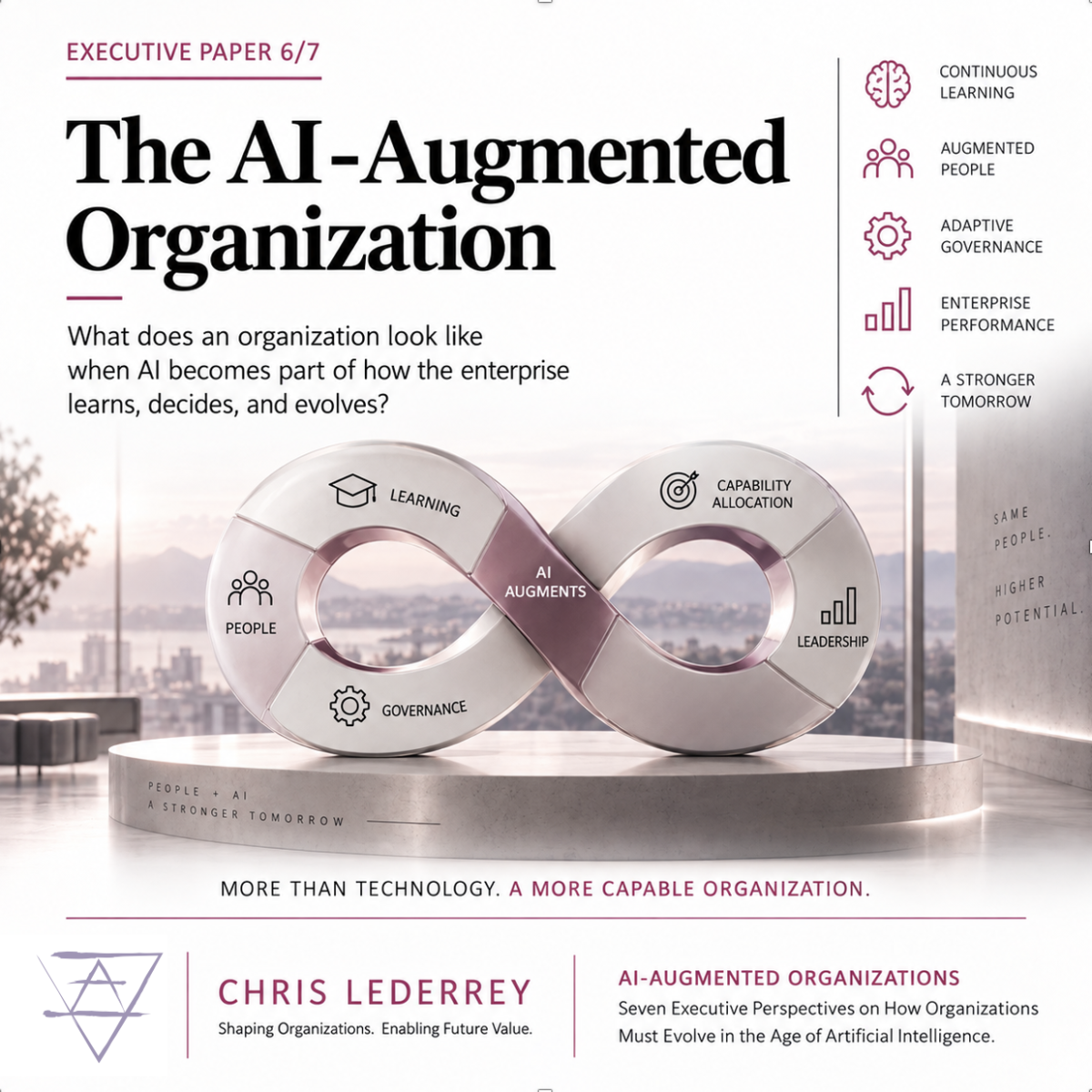
What does an organization look like when AI becomes part of how the enterprise learns, decides, and evolves?This paper is part of AI-Augmented Organizations, a series of executive perspectives on how organizations must evolve as artificial intelligence becomes part of how the enterprise decides and acts.
Estimated reading time: 7 minutes
Chris Lederrey
https://www.aetheris.ch
https://www.linkedin.com/in/chrislederrey
Executive Summary
AI usually arrives through isolated initiatives: a new forecasting model, a copilot, an agent, a planning platform, an automation project. Each may improve its own corner of the business. Almost none of them, on their own, transform how the enterprise performs.
The AI-Augmented Organization takes a different approach entirely. Instead of asking how AI can improve existing work, it continuously redesigns how the organization learns, develops expertise, allocates human judgment, governs decisions, and helps people work confidently alongside intelligent technology. AI stops being another digital initiative. It becomes part of the operating model itself.
- Technology projects create capabilities.
- Organizational transformation enables those capabilities to create enterprise value.
- Leadership orchestrates the two.
The AI-Augmented Organization isn't defined by how sophisticated its technology is. It's defined by how well it can continuously redesign itself as that technology keeps changing.
The AI-Augmented Organization
Across the last four papers, we've walked through five organizational capabilities that determine whether AI produces isolated improvement or genuine enterprise value.
None of them is sufficient by itself, and I've watched organizations prove that the hard way. I know a business that built real expertise-development programs, genuinely good ones, while leaving decision governance completely untouched; the judgment they built had nowhere authoritative to land. I know another that allocated capability with real precision, concentrating its best people exactly where uncertainty justified it, while never addressing why half the organization quietly distrusted the system doing the allocating. Redesign governance without bringing people along, and you get technically elegant authority structures nobody actually uses.
Technology alone can't compensate for gaps like these. Neither can leadership acting in isolation on any single one of them.
Enterprise transformation shows up when these capabilities reinforce each other as one coherent system, not five separate initiatives running in parallel. That, I'd argue, is the actual definition of an AI-Augmented Organization.
AI Is No Longer a Project
Most organizations still approach AI the way they approached earlier waves of digital transformation:
- identify an opportunity
- select a technology
- launch a project
- deploy the solution
- close the project.
AI doesn't fit that model, and pretending otherwise is where a lot of the disappointment comes from. Unlike most technology that came before it, AI keeps evolving after it's deployed. Models improve. Capabilities expand. New forms of automation show up faster than the project plan anticipated.
That changes the real question facing leadership. It's no longer how do we deploy AI successfully. It's how do we keep evolving the organization alongside something that won't hold still.
AI stops being a technology project. It becomes part of the organization's operating system, which means it needs the same kind of continuous attention any operating system needs.
Five Capabilities, Working as One System
An AI-Augmented Organization isn't defined by its technology stack. It's defined by five capabilities that continuously reinforce each other:
- Learning: the organization deliberately designs how future expertise gets created, rather than assuming it'll emerge naturally from routine work that increasingly doesn't exist anymore.
- Capability Allocation: human expertise gets concentrated where uncertainty, judgment, and strategic impact create disproportionate value, and nowhere else.
- Decision Governance: authority, accountability, and automation keep evolving as organizational maturity and technological capability increase, rather than freezing in place.
- Human Adoption : people understand that AI complements their expertise rather than competing with it, because the organization has deliberately built the conditions for that to be true.
- Leadership: continuously orchestrates how technology, governance, capability, and people interact with one another.None of these operates independently. Together, they form one adaptive system — and a weakness in any one of them quietly limits what the other four can achieve.
Think of AI as a Colleague, Not a Deployment
One mental model has stuck with me through this entire series. Most organizations still deploy AI the way they'd deploy a new piece of software. A far more useful frame: think of AI as a new participant in the enterprise's decision system.
Like any new colleague, it arrives with real strengths and real limitations. Trust builds gradually. Roles sharpen through actual experience. Collaboration improves over time, not on day one. Nobody expects a newly hired executive to be a fully integrated member of the leadership team in their first week. There's no reason to expect AI to be any different.
The goal was never to replace human expertise. It's to build teams, human judgment and AI together, that consistently outperform either one working alone.
The Organization Is Never Finished
Perhaps the defining trait of the AI-Augmented Organization is that it doesn't have an end state.
Learning keeps evolving. Governance keeps evolving. Capability allocation keeps evolving. Adoption keeps evolving. Leadership's job shifts accordingly, from managing a change program with a start and end date, to continuously orchestrating adaptation that never quite finishes.
Technology expands what's possible. The organization has to keep redesigning itself to actually capture that potential. Transformation stops being a destination and becomes something closer to a standing organizational capability, the kind you never fully check off the list.
A Different Way to Measure Maturity
Most organizations measure AI maturity by counting things: models deployed, pilots run, platforms live, processes automated. Those numbers matter, but they say surprisingly little about whether the organization can actually sustain the value it's chasing.
A better question: how effectively does the organization adapt itself as the technology underneath it keeps changing?
An AI-Augmented Organization measures its maturity by the quality of its learning, the clarity of its governance, the precision of its capability allocation, and the confidence with which its people work alongside AI, not by the sophistication of its algorithms. Those capabilities, not the technology, are what ultimately decide whether AI becomes a genuine source of advantage or just an expensive initiative with a good demo.
Leadership Becomes Organizational Design
This changes what leadership actually is.
Leadership is no longer primarily about deploying technology. It's not simply about managing change, either. Leadership becomes the continuous design, and redesign, of the organization itself.
- Technology projects create capabilities.
- Organizational transformation enables those capabilities to create enterprise value.
- Leadership orchestrates the two.
That orchestration doesn't end, because neither the technology nor the organization's learning about how to use it ever fully stops.
Looking Ahead
This series began with a simple, uncomfortable observation: despite unprecedented investment, many organizations still aren't getting the value they expected from AI.We've now worked through one answer. AI changes how organizations learn. How they develop expertise. How they allocate judgment. How they govern decisions. How people adopt new ways of working. Ultimately, it changes the organization itself.One question remains — and it's the one that started this whole series.
If all of this is increasingly understood, why do so many organizations still struggle to put it into practice?
The final Executive Paper returns to where this series began. Not to introduce another framework — but to close the circle.
AI-Augmented Organizations — 7/7
Why AI Projects Fail to Deliver on Their Promises
This is Paper 6 of 7 in the AI-Augmented Organizations series by Chris Lederrey.
Happy to connect on linkedIn: www.linkedin.com/in/chrislederrey
Exec paper 7/7
It Was Never a Technology Problem
AI-Augmented Organizations
Executive Paper 7/7
It Was Never a Technology Problem
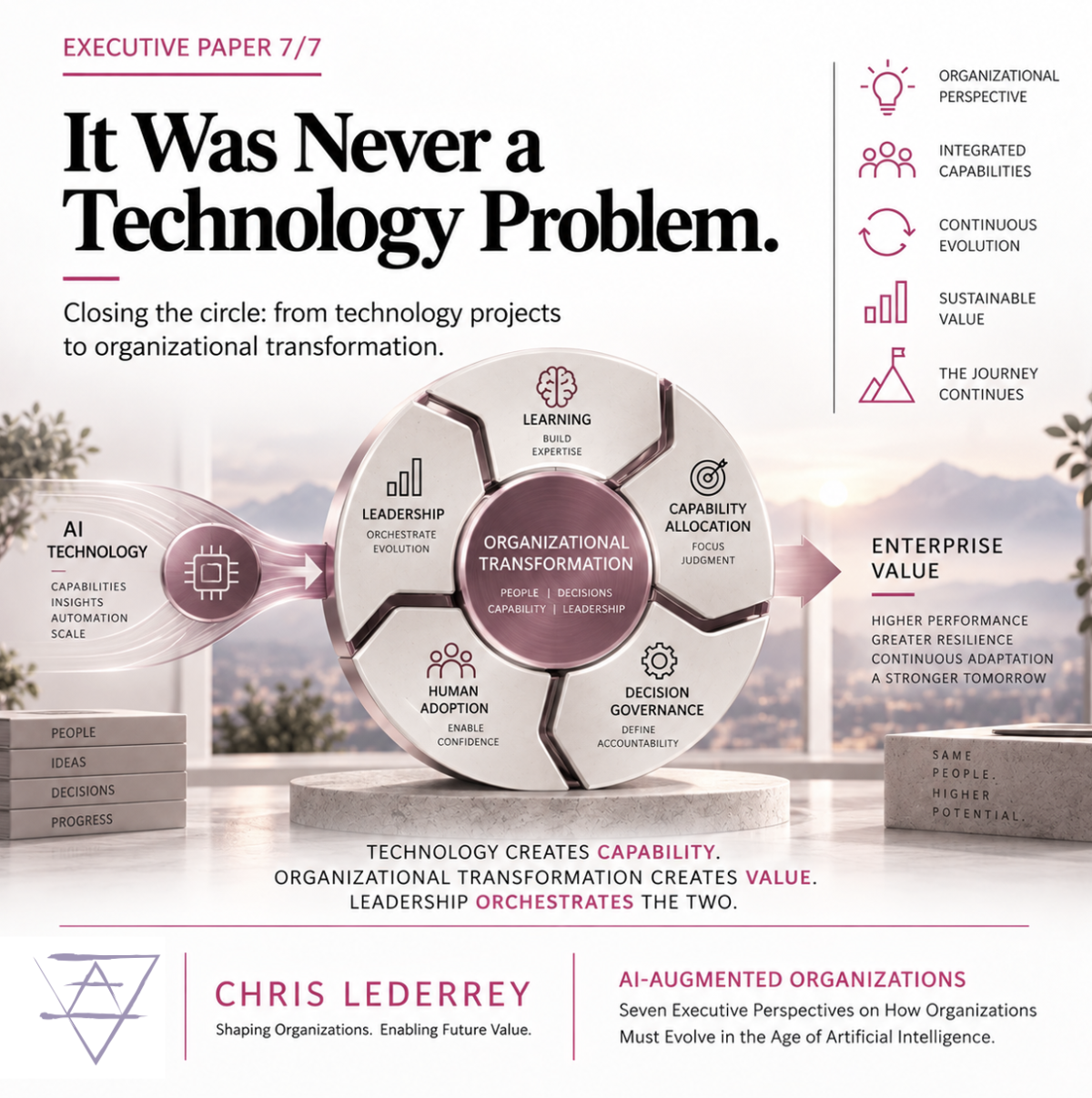
Closing the circle: from technology projects to organizational transformation.This paper is part of AI-Augmented Organizations, a series of executive perspectives on how organizations must evolve as artificial intelligence becomes part of how the enterprise decides and acts.
Estimated reading time: 7 minutes
Chris Lederrey
https://www.aetheris.ch
https://www.linkedin.com/in/chrislederrey
Executive Summary
AI rarely fails because the technology falls short. More often, organizations simply haven't created the conditions under which intelligent technology can deliver lasting value.
Over this series, we've walked through five organizational capabilities that decide whether AI becomes another isolated initiative or an integral part of how the enterprise operates:
- how expertise is created
- where human judgment gets invested
- how decisions are governed
- how people adopt new ways of working
- and how leadership continuously orchestrates all of it.
Looked at individually, these look like five different problems. Looked at together, they reveal one.
AI implementation was never primarily a technology challenge. It has always been an organizational one.
Technology projects create capabilities. Organizational transformation enables those capabilities to create enterprise value. Leadership orchestrates the two.
The organizations that benefit most from AI won't simply deploy better AI. They'll continuously redesign themselves to keep creating value from it.
It Was Never a Technology Problem
This series opened with a COO and a forecasting model his team genuinely admired, more accurate than anything they'd had before. Six months in, planners were still overriding it by hand, because the sign-off process for a forecast hadn't changed since before the model existed. The algorithm had improved. The decision it fed into hadn't.
I've carried that image through all six papers since, because it's the whole argument in miniature.
Organizations everywhere are investing unprecedented amounts in AI, and executives keep describing the business impact as disappointing anyway. The explanations are remarkably consistent: poor data, poor adoption, poor governance, poor AI literacy, poor explainability, resistance to change. Every one of them contains some truth. None of them fully explains why organizations keep landing in the same place despite addressing each issue individually. Maybe because they were never separate problems to begin with.
One Problem. Many Symptoms.
Run the Five Whys we opened this series with, and it still lands in the same place it did in Paper 1: not on a data problem, or a skills problem, or a trust problem, but on an organization that installed new capability into decision systems nobody had redesigned.
- Learning.
- Capability allocation.
- Decision governance.
- Human adoption.
- Leadership.
Looked at separately, each deserved its own paper, and got one. Looked at together, they're all downstream of a single question: how should an organization evolve when intelligent technology fundamentally changes the nature of work and decision-making?
That question was never technological. It was organizational from the first page.
AI Changes Organizations Before It Changes Performance
One thing has become unmistakable to me over the course of this series: organizations expect AI to improve performance while leaving the organization itself largely untouched. History says the opposite is true. Every major technological shift has eventually reshaped how organizations operate, AI just accelerates the timeline.
It changes how expertise gets created. Where judgment creates value. How authority should be allocated. How people actually collaborate. Ultimately, it changes how the enterprise creates value at all.
Technology turns out to be only one component of the transformation. Organizational evolution is the part that actually decides the outcome.
Why Organizations Stop Too Early
There's a simple reason so many organizations stall exactly where this series predicted they would.
Technology projects feel familiar: budgets, timelines, deliverables, a project manager who owns the outcome.
Organizational redesign doesn't offer any of that comfort. It crosses functions. It challenges governance. It questions incentives nobody's touched in a decade. It redistributes authority that people have quietly assumed was theirs.
So organizations stop where the project ends. Unfortunately, enterprise transformation almost always begins exactly where the project finishes, which means most organizations are declaring victory one step before the work that actually mattered.
A Different Leadership Conversation
Maybe the executive conversation about AI needs to change shape entirely.
Instead of asking how can AI improve this process, leadership should increasingly ask: How should our organization evolve now that AI exists?
That's a small shift in wording and a large shift in substance. Technology becomes one element of a much bigger organizational conversation. Learning becomes strategic. Capability becomes deliberate. Governance becomes dynamic. Human adoption becomes an executive responsibility, not a training-department deliverable. Leadership becomes continuous organizational design. AI stops being the destination. It becomes the catalyst.
Closing the Circle
This series opened with one idea: artificial intelligence is usually presented as a technology transformation. In reality, it's an organizational one. Everything since has simply been unpacking what that means in practice.
Organizations create expertise. Organizations allocate human judgment. Organizations govern decisions. Organizations enable adoption. Organizations continuously redesign themselves. AI changes every one of those capabilities, which is exactly why it can't be delegated to a technology roadmap alone.Technology projects create capabilities. Organizational transformation enables those capabilities to create enterprise value. Leadership orchestrates the two.
That's the sentence this entire series has been building toward. Everything else was detail.
One Final Reflection
The organizations that benefit most from AI probably won't be the ones with the largest AI budgets, or the ones deploying the most models.
They'll likely just be the ones that got better at learning. Better at adapting. Better at redesigning themselves when the ground moved.
Technology will keep evolving at a pace none of us can fully predict. The durable advantage may turn out to be something far more familiar than any algorithm: an organization's ability to keep evolving alongside it.
Final Thought
This series has deliberately avoided predicting what AI will become. Instead, it asked a different question: what kind of organizations do we need to become, if intelligent technology keeps becoming part of how enterprises learn, decide, and create value?
The answer will keep evolving. That might be the last lesson worth taking from all seven papers.
An AI-Augmented Organization is never finished. Neither is leadership.
This is Paper 7 of 7 in the AI-Augmented Organizations series by Chris Lederrey.
Happy to connect on linkedIn: www.linkedin.com/in/chrislederrey