
Exec paper 1/7
AI-Augmented Organizations - Executive Paper 1/7
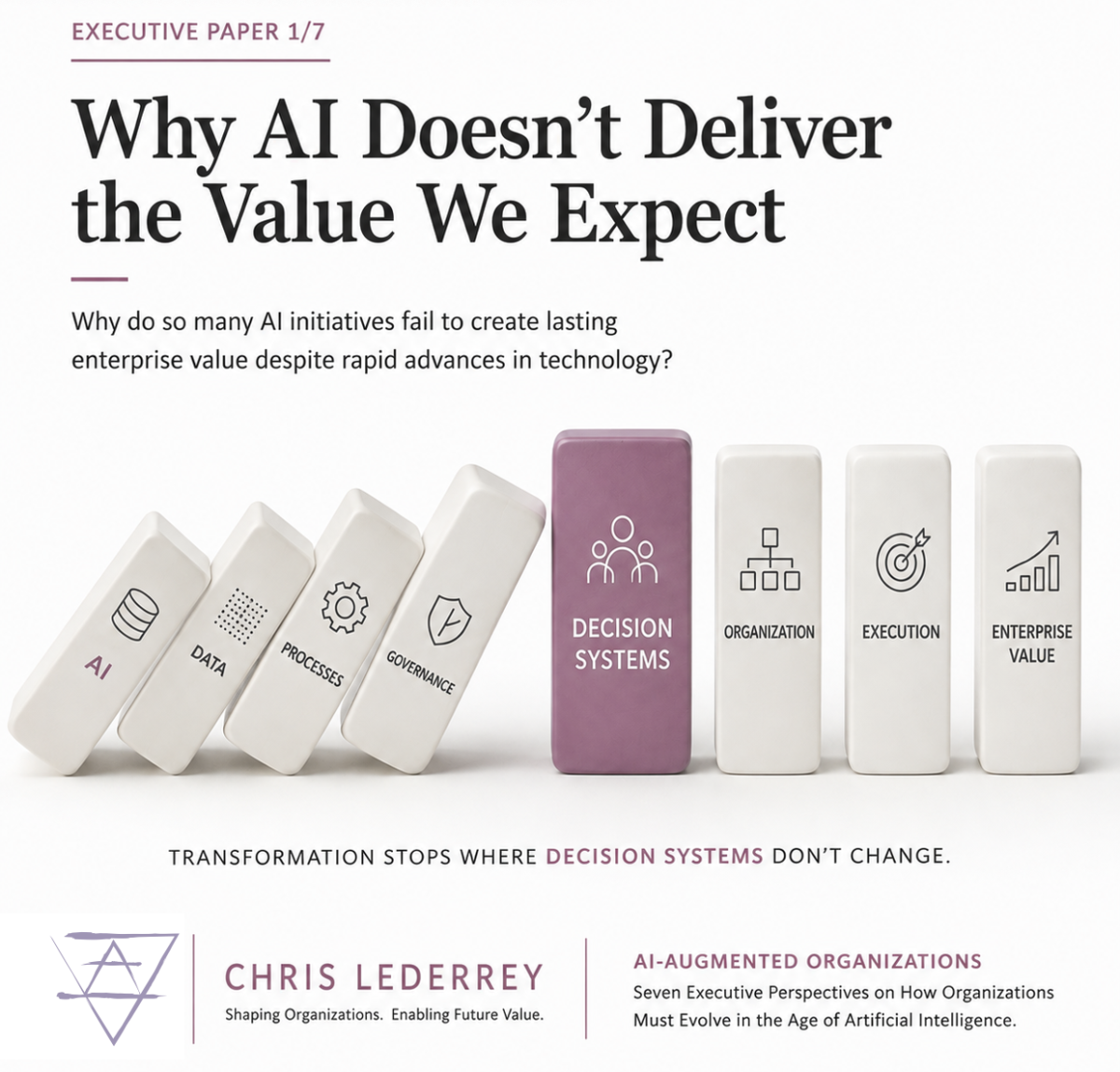
Why AI Doesn't Deliver the Value We ExpectThis paper is part of AI-Augmented Organizations, a series of executive perspectives on how organizations must evolve as artificial intelligence becomes part of how the enterprise decides and acts.
Estimated reading time: 6 minutes
Connect with me on LinkedIn: www.linkedin.com/in/chrislederrey
Executive Summary
Every board these days asks some version of the same question:
We've invested in platforms, models, copilots, agents, so why hasn't the value shown up on our numbers?
The usual answers; bad data, weak skills, low trust, resistant culture, immature governance, are all real. But they're symptoms, not causes. The deeper issue is that we've installed new AI capability into an old operating model and hoped the algorithms would do the rest of the work for us. They don't. They do the opposite: they magnify the friction between new technology and pre-AI ways of deciding.Technology gives us new capability. Organizational transformation is what turns that capability into enterprise value. Leadership's job is to orchestrate the two, and that's the real subject of this paper.
Why AI Doesn't Deliver the Value We Expect
Artificial intelligence has moved from the lab to the boardroom faster than almost any technology I've seen in my career. Copilots, predictive models, autonomous agents, decision-support systems, the pace of deployment across industries has been remarkable, and the technology itself has largely earned its reputation.
And yet, in conversation after conversation, executives tell me the same thing: the business impact has fallen short of what was promised.
I talked recently to an executive who had rolled out a demand-forecasting model that his team genuinely liked, more accurate than anything they'd had before. Six months in, planners were still overriding it by hand, because the sign-off process for a forecast hadn't changed since before the model existed. The algorithm had improved. The decision it fed into hadn't. That gap is the story of this entire paper.
AI sharpens a task here, speeds up a process there, produces a pocket of productivity somewhere in the middle of the org chart, but it rarely moves the performance of the enterprise as a whole. When that gap shows up, we tend to reach for the same explanations. We point to poor data quality. We blame incomplete master data. We fund another AI literacy program. We tighten change management. We ask the vendor for a more explainable model. We add another layer of governance. Every one of these gets funded. Yet, none, on its own, gets us there. None of that is exactly wrong. Each of these matters, and I'd be the first to fund a fix for any of them.
The problem is that we treat them as root causes, when most of the time they are symptoms of something we haven't been willing to look at directly.
The Question Nobody Wants to Ask Five Times
There's a discipline I learned early in operations and still rely on: the 5 Whys. Instead of stopping at the first plausible explanation, you keep asking why until you hit something you can actually act on.
Run it on AI transformation and the conversation gets uncomfortably familiar, fast.
The AI's recommendations aren't reliable.
- Why? Because the underlying data is inconsistent.
- Why? Because ownership of that data is split across functions.
- Why? Because our processes were never built to produce one consistent version of enterprise data in the first place.
- Why? Because governance is still organized function by function, not around the decision itself.
- Why? Because we introduced AI on top of the organization we already had, instead of asking what decisions this organization now needs to make differently.
By the fifth why, we're no longer talking about technology at all. We're no longer asking whether the model is accurate enough. We're asking whether the organization has actually changed.
Projects Change Parts. Organizational Transformation Rethinks the Whole.
This is, I think, the real reason so many AI initiatives stall well short of their potential.
Cleaning up data quality is a project. Deploying a new forecasting model is a project. Training the workforce on generative AI is a project. Each comes with a scope, a budget, an owner, a timeline, the things we know how to manage.
Redesigning how the enterprise makes decisions is a different order of problem entirely.
It changes how functions work with one another. It changes who sits at the table when a decision gets made. It changes who holds the authority to make the call. It changes what people are accountable for, how they're incentivized, and ultimately where value gets created across the business.
What started as a technology initiative quietly turns into an organizational transformation, and it rarely stays inside the four walls of the function that started it. Supply Chain organization, for instance, can redesign much of its own house on its own authority. But the moment its decisions touch Commercial, Finance, Manufacturing, Procurement, or a regional P&L, governance stops being a local matter. New conversations must happen. Interfaces that have worked one way for years have to change. Assumptions about who owns what get challenged, sometimes for the first time in a generation.
Deploying the technology, it turns out, is the easy part. Redesigning the organization around it is the real executive challenge.
Why We Keep Solving the Easier Problem
There's a second reason we keep circling back to the same fixes.
Data quality is something you can point to. Technology is something you can procure. A training program has a start date and an end date. Decision systems don't offer us any of that comfort, they're invisible until something goes wrong.
It is far easier to launch a master data program than to redesign how your executive team actually makes decisions together. It is far easier to retrain a forecasting model than to settle who owns the forecast. It is far easier to buy another AI platform than to build the organizational conditions under which people will actually trust it enough to use it.
So we optimize what we can control, and we quietly postpone the harder work of redesigning the enterprise itself. I understand why, I've made that trade myself. But it's also, I'd argue, the single biggest reason enterprise value keeps slipping through our fingers.
From Technology Transformation to Organizational Transformation
Maybe we've simply been asking the wrong question.
Instead of asking: "How do we deploy AI?”
We should be asking:"How does our organization need to evolve so AI can keep creating value?"
That single reframe changes the whole conversation. It moves us from algorithms to decision systems. From tools to organization design. From project plans to leadership.
- Technology projects create capabilities.
- Organizational transformation enables those capabilities to create enterprise value.
- Leadership orchestrates the two.
Artificial intelligence is no longer just another line on the digital roadmap. It's an enterprise redesign challenge. And that, more than any shortfall in the technology, may be the real reason so many of us are still waiting for the value we were promised: redesigning how an enterprise makes decisions is one of the hardest things leadership will ever be asked to do.
Looking Ahead
If the real constraint is organizational rather than technological, the next question is no longer how to deploy better AI. It's far more fundamental. How do organizations redesign the way they make decisions?
That question can't be answered by technology alone. It requires us to rethink how expertise is developed, where human judgment creates the greatest value, how decisions are governed, and how the organization itself adapts to increasingly intelligent technology. The first of these challenges may also be the one we've overlooked the most. If AI increasingly performs the work through which professionals have historically built their expertise, the early drafts, the first analyses, the small errors that teach as much as the successes, a harder question follows close behind.
How will organizations keep creating the expertise needed for reliable judgment on which good decisions have always depended?
That's where we begin next.
AI-Augmented Organizations — 2/7 The AI Learning Paradox
Executive papers
These papers are not intended to provide definitive answers. They are an invitation to reflect on how organizations, leadership and intelligent technologies are evolving and to continue that discussion together.